Hyundai Porter 2020
Descriptions:
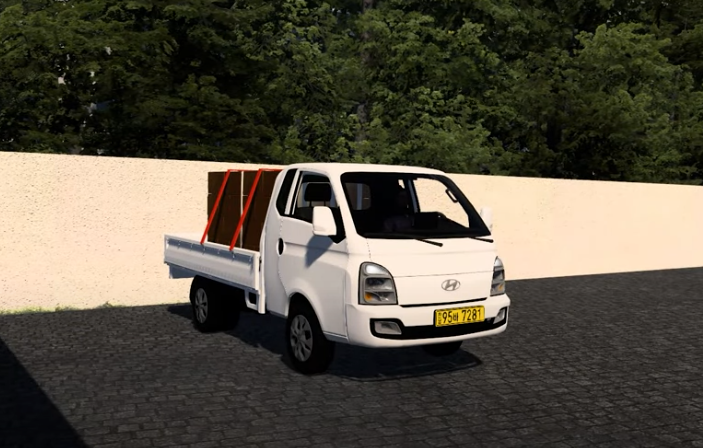
The Hyundai Porter (also known as the Hyundai H-100 in some markets) is a popular light commercial truck, widely used for various cargo and delivery purposes, especially in Asia, the Middle East, and parts of South America. The 2020 model year continued the fourth generation of the Porter, offering a balance of practicality, efficiency, and robustness for businesses.
Here’s a detailed overview of the 2020 Hyundai Porter:
Key Characteristics and Features:
Body Styles: The Porter is primarily offered as a cab chassis with various bed configurations (flatbed, drop-side, enclosed box, etc.). It’s available in Standard Cab, Super Cab (extended cab), and Double Cab variants, catering to different passenger and cargo needs.
Seating Capacity: Typically 3 seats in the standard and super cab, and up to 5 or 6 in the double cab models.
Market Position: It’s known as a reliable and economical workhorse, popular among small and medium-sized businesses for urban deliveries and light-duty hauling.
Design: The design is functional and practical, with a focus on maximizing cargo space and ease of loading/unloading. The 2020 model retained the familiar no-nonsense styling.
Engine and Performance (2020 Model):
The 2020 Hyundai Porter generally offered a choice of diesel engines, with regional variations:
2.5L CRDi Turbo Diesel (A2 engine): This is a common engine option, providing more power and torque.
Displacement: Approximately 2,497 cc.
Max Power: Around 130 PS (96 kW) at 3,800 rpm, though some variants might offer up to 133 PS.
Max Torque: Roughly 26 kg·m (250-260 Nm) at 1,500-3,500 rpm.
Transmission: Typically paired with a 6-speed manual transmission, and a 5-speed automatic transmission was also available.
2.6L Diesel (T2 engine): In some markets, an older, naturally aspirated 2.6L diesel engine (D4BB) was also available.
Displacement: Approximately 2,607 cc.
Max Power: Around 79-80 PS (58 kW) at 4,000 rpm.
Max Torque: Around 17 kg·m (167 Nm) at 2,200 rpm.
Transmission: Usually a 5-speed manual.
Fuel Efficiency: The 2.5L CRDi engine offered improved fuel efficiency, with combined figures around 9.0-9.9 km/L depending on the variant and transmission.
Drivetrain: Primarily Rear-Wheel Drive (RWD), with 4WD options available for certain configurations, enhancing capability on unpaved roads or challenging terrains.
Dimensions (Approximate, as variations exist based on cab/bed type):
Overall Length: Ranges from approximately 4,810 mm to 5,175 mm (for Extra Long versions).
Overall Width: Approximately 1,740 mm (excluding mirrors).
Overall Height: Around 1,970 mm to 2,100 mm.
Wheelbase: Commonly 2,430 mm or 2,640 mm (for longer versions).
Cargo Body Length: Varies significantly, from roughly 1,860 mm (Double Cab) to over 3,100 mm (Extra Long Standard Cab).
Cargo Body Width: Around 1,610 mm to 1,650 mm.
Cargo Body Height: Approximately 355 mm (drop-side) to 1,850 mm (box body).
Payload Capacity:
The Hyundai Porter is generally known for its robust payload capacity, often rated around 1,000 kg to 1,300 kg (1 to 1.3 tons), depending on the specific model and configuration. Some regions or specific variants might have slightly different official ratings.
Gross Vehicle Weight (GVW) typically ranges from 3,000 kg to over 3,065 kg.
Interior and Comfort:
While primarily a work vehicle, the 2020 Porter offered a practical and reasonably comfortable cabin for its class.
Features often included:
Air conditioning (optional or standard depending on trim/region).
Power steering.
Power windows.
Basic audio system (CD/USB/Bluetooth on some trims).
Comfortable seating, with some premium trims offering a ventilated driver’s seat and heated seats/steering wheel.
Storage compartments.
Newer features in some 2020 models and later include:
Digital instrument cluster.
8-inch display audio with phone projection.
Proximity key with push-button start.
Safety Features:
Depending on the market and trim level, the 2020 Porter could be equipped with:
Driver and passenger airbags.
Anti-lock Braking System (ABS).
Electronic Stability Control (ESC) / Vehicle Stability Control (VSC).
Hill-start Assist Control (HAC).
Rear parking sensors/reverse warning buzzer.
Some advanced safety features like Forward Collision-avoidance Assist (FCA) and Lane Departure Warning (LDW) began appearing in later 2020 models or specific premium trims, particularly for the South Korean domestic market.
Hyundai Porter II Electric (EV):
Notably, in December 2019, a battery-electric version, the Porter II EV, was launched in South Korea.
Range: Claimed range of approximately 211 km on a full charge.
Power: 135 kW (181 hp) and 395 N⋅m (291 lbf⋅ft) of torque.
Battery: 58.8 kWh battery.
Availability: Initially only available in South Korea, primarily with the long wheelbase and extended cab. This marked Hyundai’s move into the electric commercial vehicle segment.
The 2020 Hyundai Porter continued its legacy as a versatile and dependable light truck, meeting the demands of various commercial applications with a focus on durability and cost-effectiveness.
Authors:
gest
Download Link: Download mod
* By clicking [Download mod] button you agree to leave this website. The link opens in the new tab. File is hosted in the external website. We are not responsible for the content of the external page and the possibility of free download of the file.